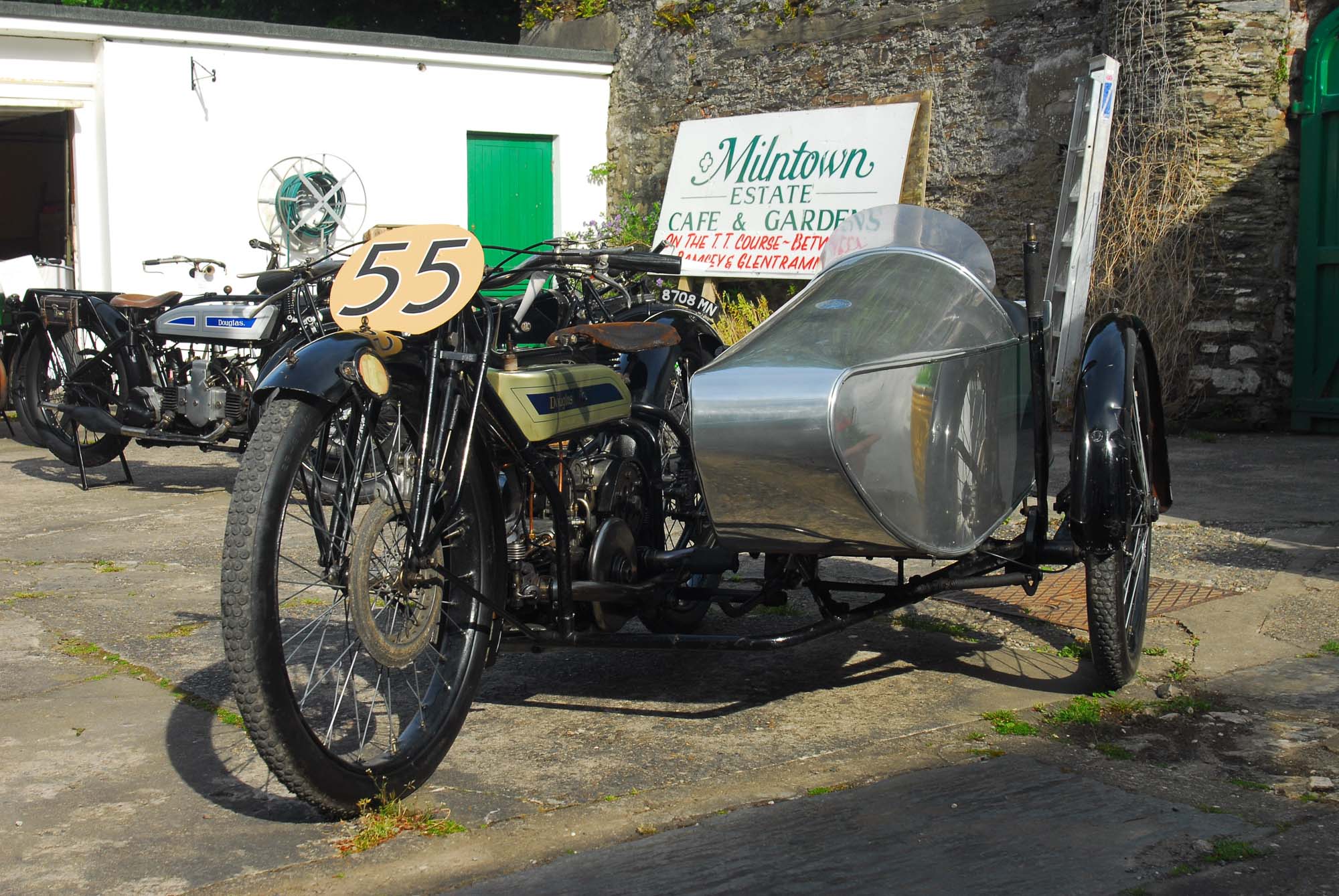
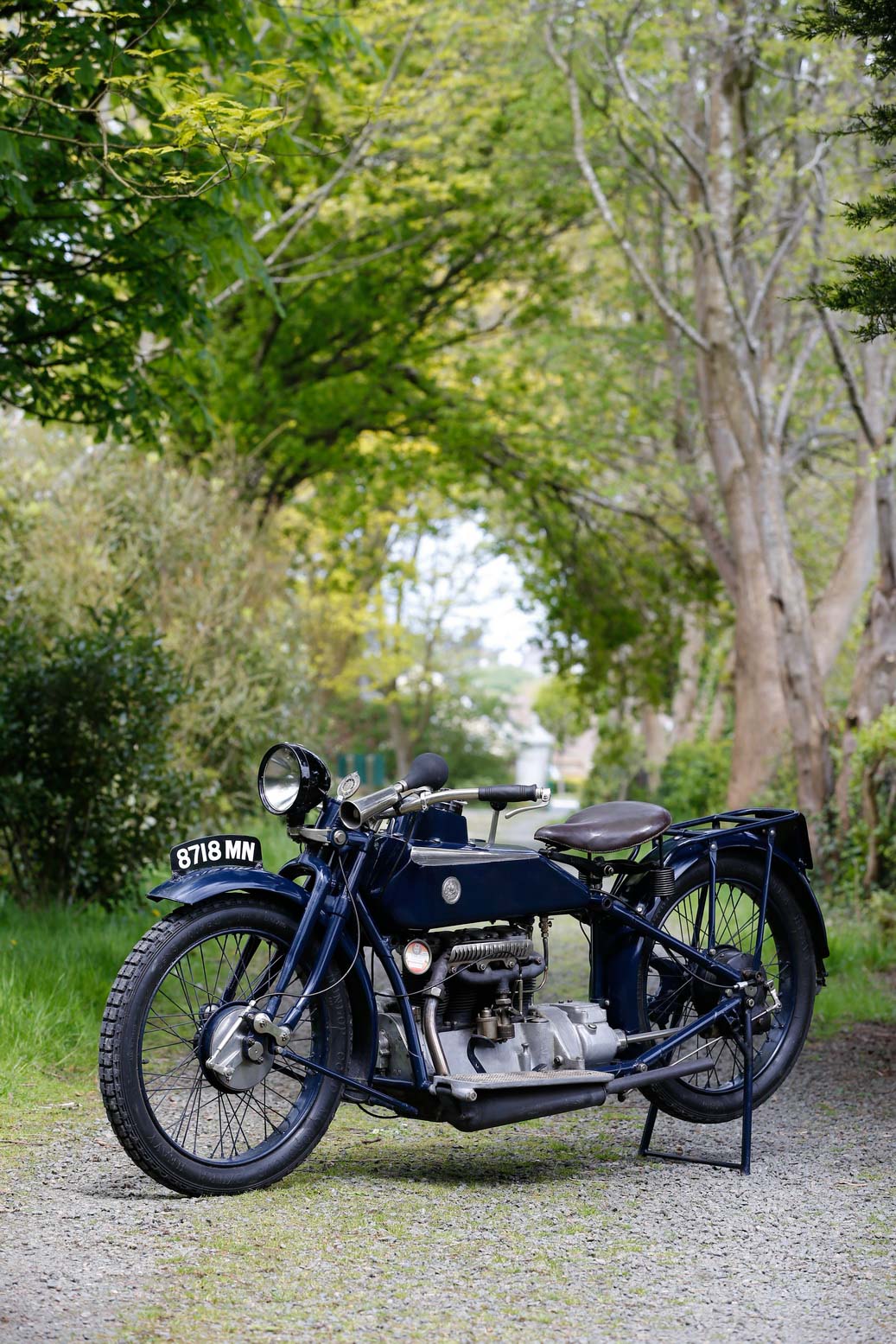
The Freddie Dixon Banking Sidecar – Winner of the first Sidecar TT in 1923
This bike is of course not the original Freddie Dixon one, but it is a 1923 R.A. – Frame no CF 20 Eng No FE 20 and as near as is possible to identical. Bob Thomas was in touch with Mr E L Denney (brother of Walter the passenger in 1923) who both built the side-car and did most of the work on the bike.
Fred had several modifications, one of which was to the oiling, which originally was “Total Loss” by means of a hand pump (lever on right handlebar) contained in the castali oil tank below the engine. This could easily flood the engine with oil, so Fred cut a large hole about 1″ diameter in both crankcase and tank, sealed the gap with a rubber ring, and let the oil drain back to the tank. Large breathers were added to cope with crankcase compression.
It is not generally known that there was an ingenious telltale metering valve for the oil supply. This is in the petrol tank near the front. When the spring loaded pump is delivering, the telltale knob lifts. Rotating the knob brings succession of different size holes into line with the outlet, ranging from almost nil to full-bore.
The attention to detail is worth note, as no bolt is used where a tube and split pin can serve, all bolts where it was permissible are hollow, all frame lugs are scarfed and tapered to the limit. Mudguards were of aluminium, wheel rims of special alloy and very light, and extensive use of special steel alloys even permitted the rear wheel spindle to be “waisted” down to 3/8″ between threaded portions.
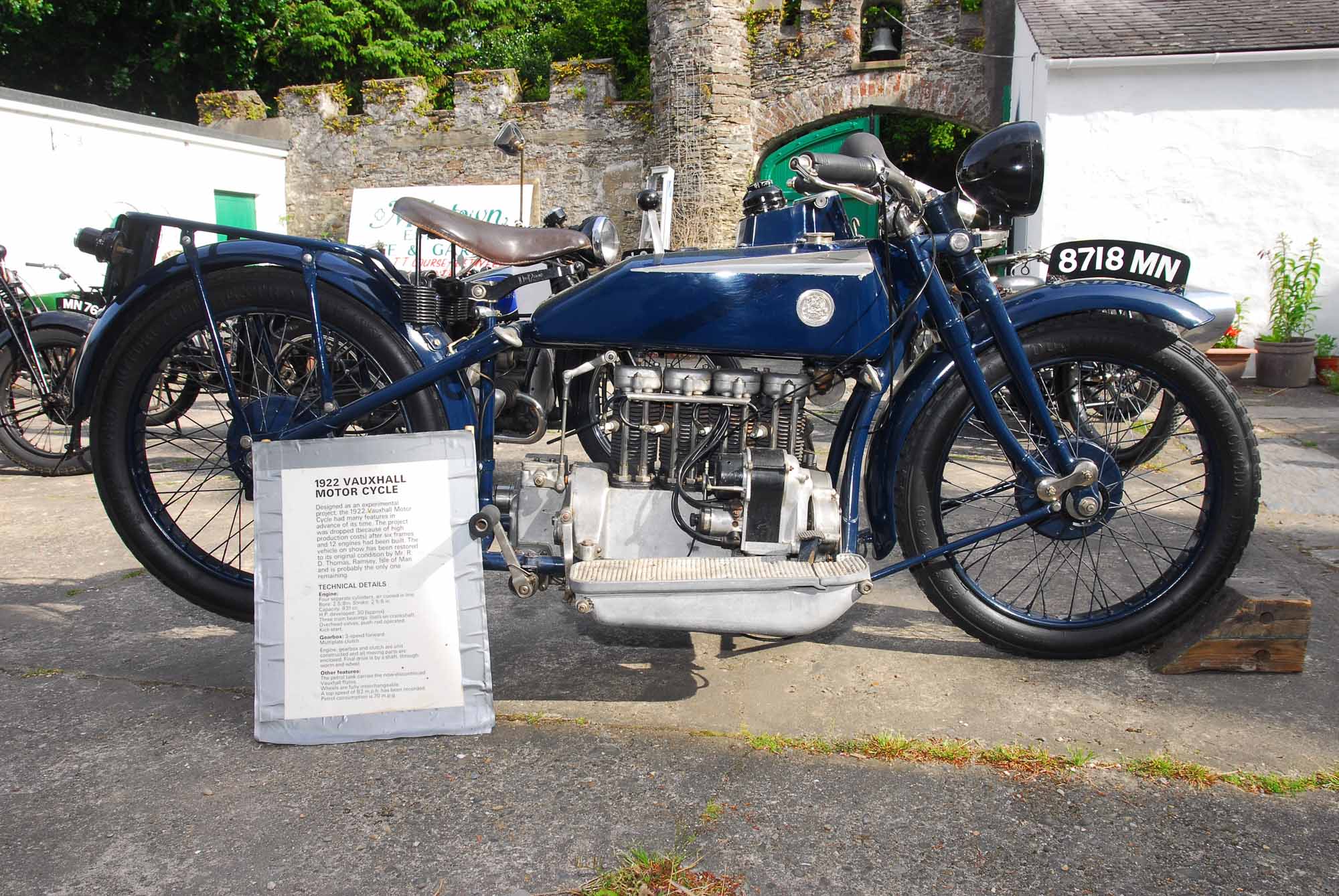
This is a completely unique motorcycle, one of two experimental machines built by the then Vauxhall Motors at Luton. This machine is Number Two, the Number One is known to have been broken up for scrap by car breakers West’s of Denmark Street of Oxford sometime in 1935/6.
It was given to Bob Thomas in pieces in 1952 by one Stan Sherwood of Wembley, he had bought it about 1936 complete, but dismantled it. He in turn gave it to a friend, he recovered it, still in pieces, then the war started. Whilst he was making it ready to be brought indoors some over enthusiastic salvage collectors took away the frame, part of the front forks, the petrol tank and several other pieces for scrap! Fortunately he kept what was left! Bob was put in touch with the then Chief Designer at Vauxhalls, they still had prints of the original drawings of which they gave him copies. The machine had been designed for Vauxhall by Frank Halford of Ricardo Engineering of Shoreham by Sea. Using these drawings over some seven years Bob was able to make the missing parts, the Vauxhall Apprentices School made the new petrol tank and were generally very helpful. It first ran after rebuilding in 1957. Many parts had to be fabricated by hand, for example the rear blades for the front forks were made from a 2×1″ flat steel bar, the induction/exhaust maniford is fabricated from water fittings etc.
There are no instruction, but it is all straightforward, the engine takes normal straight engine oil Castrol GTX or similar, the final worm drive must have Castor based oil. Other parts are just oiled as required. Tappet Clearances are nil cold, there are oilers in each rocker box, these feed by wicks to the rockers themselves.

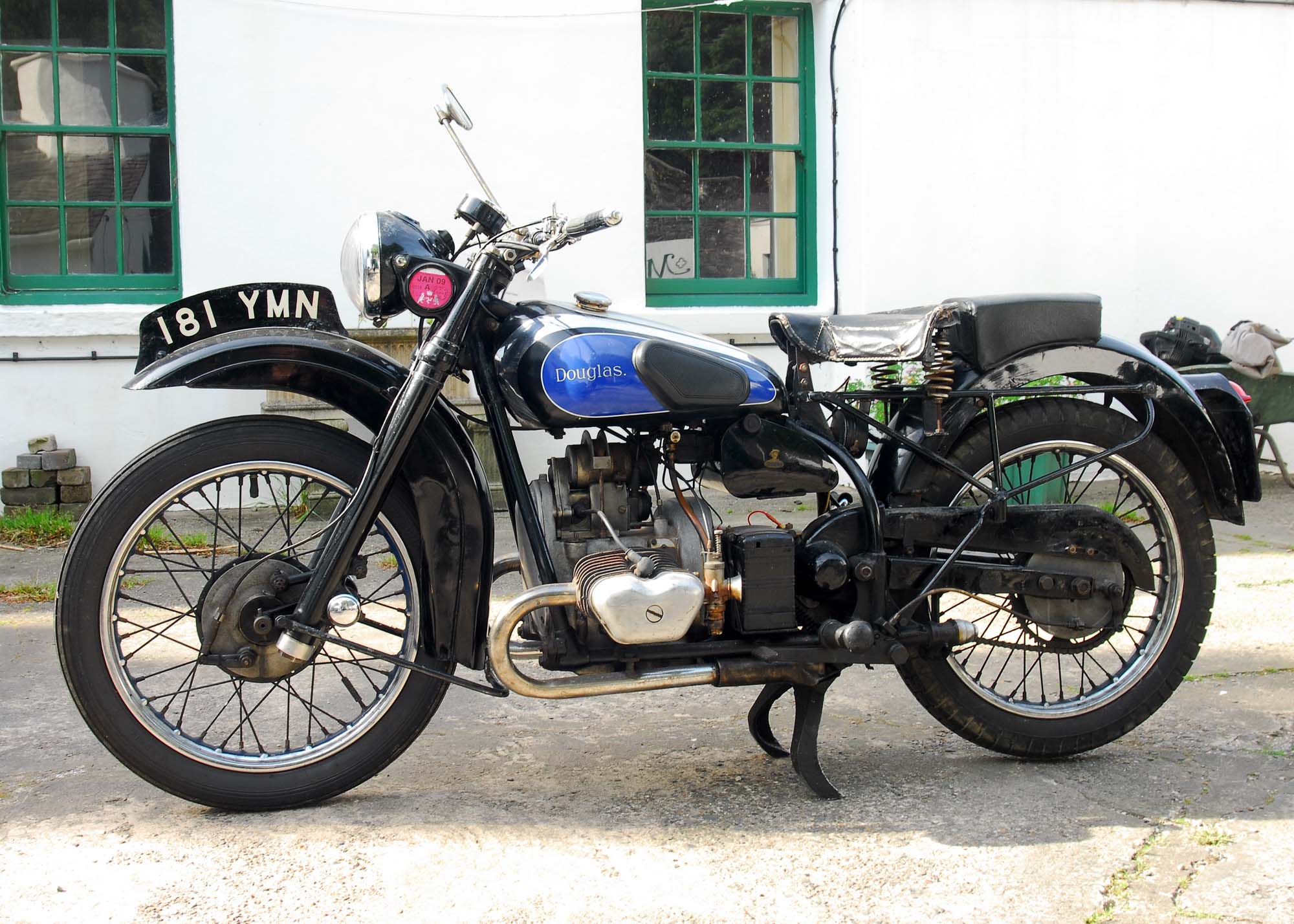
This is a standard Mk 111 machine bought new by Bob Thomas in 1949. Bob sold it to his friend George Heywood about 1954 and got it back in 1970.
A standard A.B.C with full weathershields. Apart from having a proprietary set of valve rockers (by Jarvis) it is in standard trim.

A very popular model in its day, the engine designed by Freddie Dixon is almost unburstable, heavy, but trouble free. This is the “touring” version, which used the earlier front forks with two side springs, the sportier models had a centre spring and a degree of damping.
No special instruction are needed, obvious lubrication and the engine oil is contained in the sump beneath the engine. Flywheel clutch is cork lined, but takes quite a bit of abuse.

This is the oldest known A.B.C motorcycle. It was made as a prototype for the 1913 model. Designed by Granville Bradshaw, it is said to have been used by him as his personal machine. It was bought in 1916 by R.C. Meeson of London and used by him until 1926, with a sidecar for which Mr Meeson made his own chassis of flat spring steel, which he claimed was copied by the Rudge Whitworth Concern for their own sidecars. The bike was bought by Bob Thomas in 1946 from Mr Maclachlan of the RAC, who had not managed to obtain the necessary spares. Bob later got to know Mr Meeson who lived only three miles away. He told Bob that he had covered over 70,000 miles on the bike with only one breakdown, he travelled from London to North Wales regularly. After laying up the bike he used the engine to drive a generator for lighting his bungalow until 1939. The engine was rather worn.
By one of those coincidence, it was at a Vintage Club committee meeting that Bob was told about the bike by Reg Ashton. Stan Johnson said he knew where he could get a brand new engine for it. After rebuilding it Bob was asked to take it to Mr R E “Bob” Dicker at Addlestone, who had worked for ABC at Brooklands. He was very surprised, to quote he actual words he said “Christ Almighty, where the hell did you dig that up – I made that!” He recalled many pieces of information that were to prove useful. It is interesting that after World War 1 Bob was the Vickers mechanic sent out to Newfoundland to assemble the Vickers Wimy plane in which Allcock and Brown made the first non-stop trans-Atlantic flight. At the time Bob met him he had just restored a 1924 2 3/4 Douglas for his brother, Bob subsequently bought it.
This A.B.C is fitted with “leaf” rear suspension, an Armstrong three-speed hub gearbox used as a countershaft gearbox, on the mainshaft of which the rear suspension pivots, giving constant chain tension. It has a 500cc engine with steel cylinders, exhausted-over-inlet valve arrangement, all ball or roller bearing except the little ends. A Claudel-Hobson carburettor and Best and Lloyd oil pump. The magneto is by Rudhart.


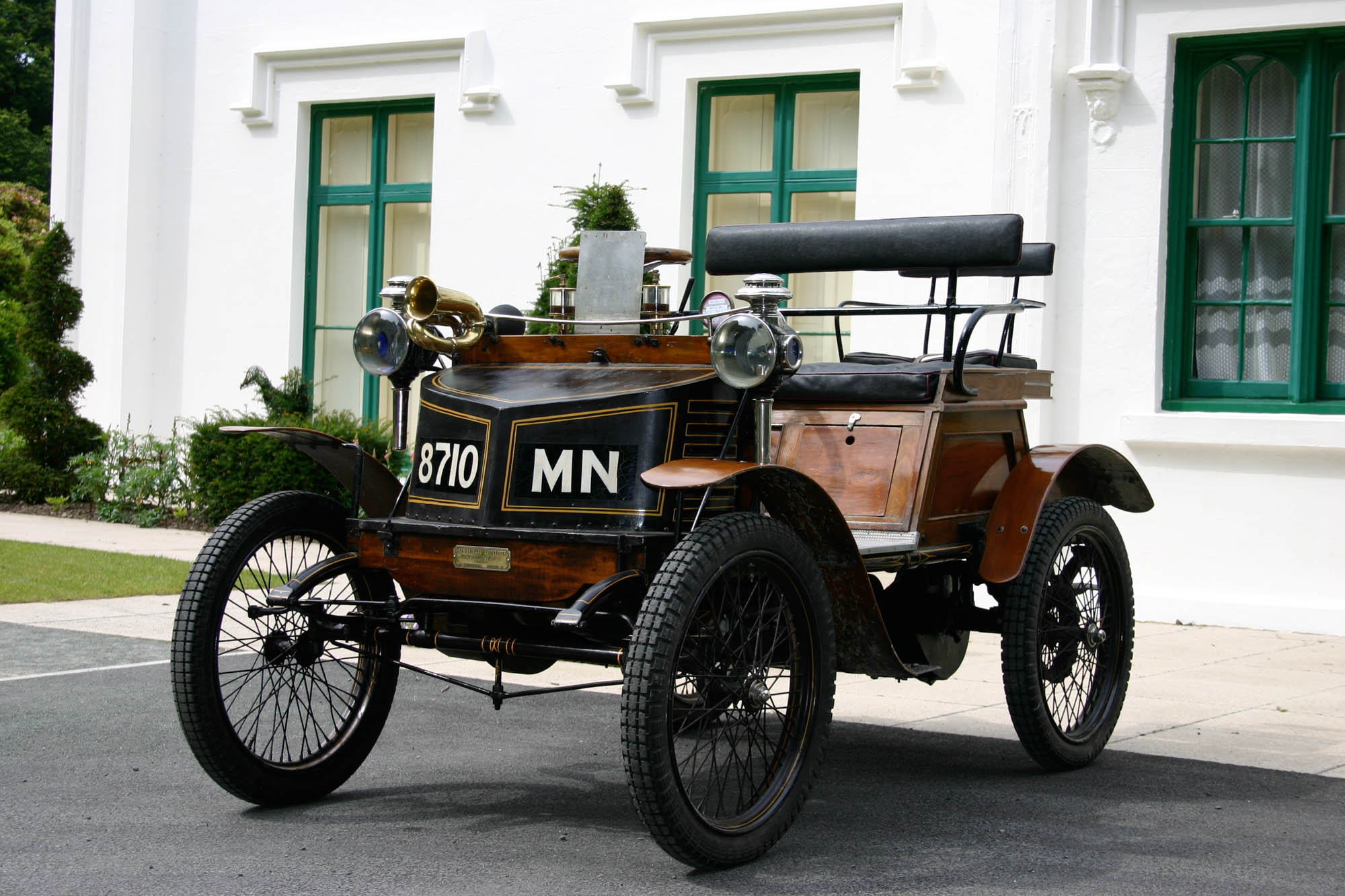
The New Orleans, built in 1900, is the oldest car in the Milntown collection. Despite its name it was built in England in what had been the stables of Orleans House, Twickenham, once the home of the Duke of Orleans. It is believed to be the only two-cylinder New Orleans in existence, although three-cylinder versions are known. It was bought by Sir Clive Edwards (the late owner of Milntown) in 1945 from the estate of the original owner, a Mrs Hartland. She lived in Chepstow, Monmouthshire. At the time it still retained its original registration number of AX 74. The design of the New Orleans was based on a Belgian car called the Vivanus but was altered in minor ways by the makers, a firm called Burford and Van Toll. It is a very simple car, as were most light cars of 1900. It has a vertical twin cylinder engine, which is in fact just two single cylinder engines on a common crankshaft. In what was common practise at the time it has what were called “automatic” inlet valves controlled by a light spring. These were opened by the sucking action of the downward movement of the piston, with no mechanical control whatever – effective, but not very efficient! The engine drives a two-speed gearbox mounted on the back axle by means of a flat belt from a pulley between the two cylinders, the belt being crossed to give a better grip on the pulleys. The belt is moved from a fixed pulley to a free one by means of a foot pedal, thus serving as a simple clutch. All the axle and gearbox shafts run in ball bearings made by the BOWN Company, who were the originators of practical ball bearings. The ignition is provided by a battery and what is known as a Trembler Coil, a device which provides a continuous spark so long as a contact is maintained. This is controlled by cams on the engine which provide contact at the appropriate times to make the engine fire. The brakes are of the external contracting type, being a contracting band around a drum. They work well, but only in one direction. Going backwards they are useless! To counter this problem, in the event of the car stalling on a hill, a device called a sprag brake is fitted. This is just an angle faced bar, fixed to a shaft, which drops onto the road and digs into the surface when the holding-up cable is released! The New Orleans has completed the London to Brighton veteran car run on at least 30 occasions.
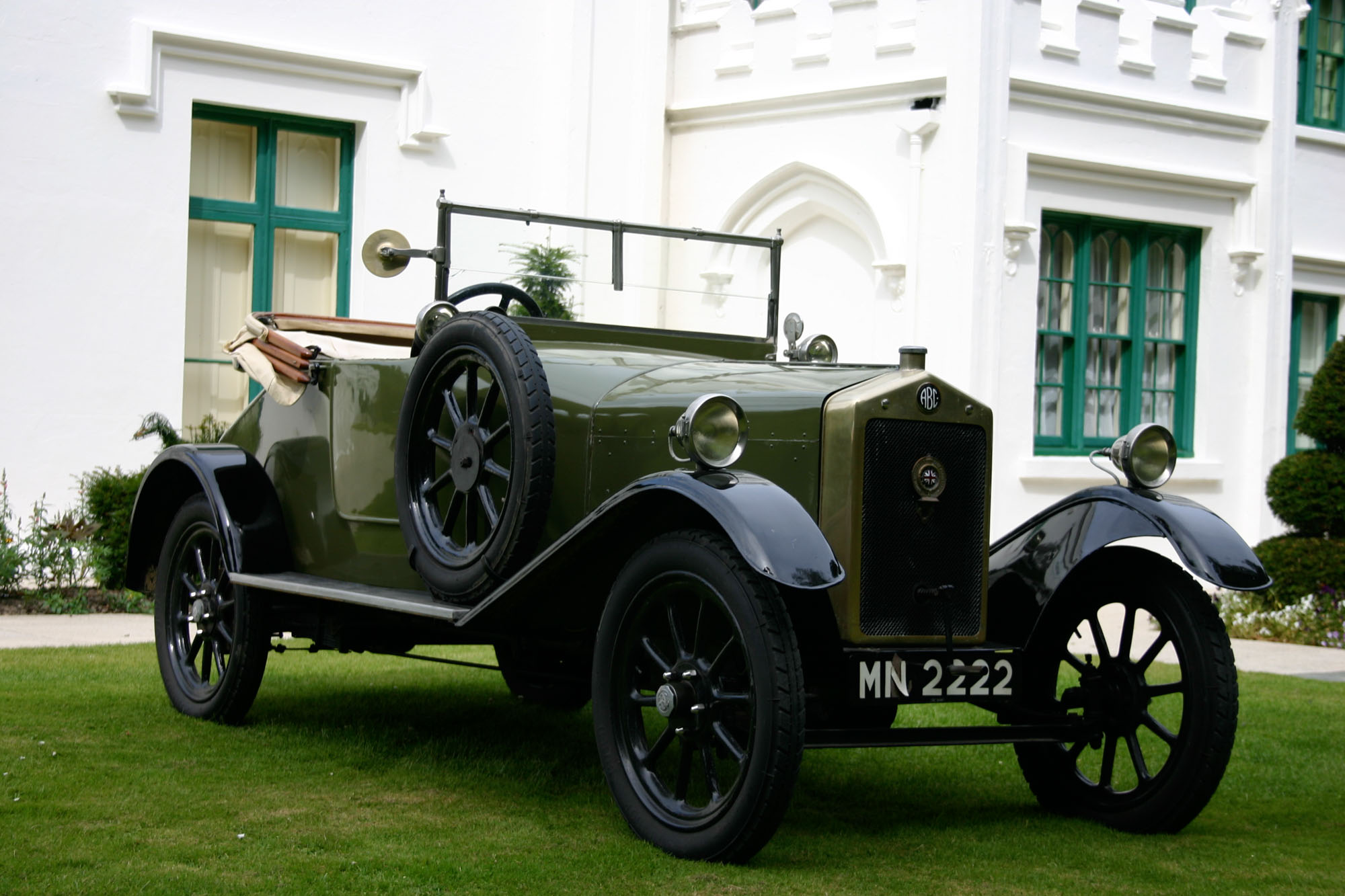
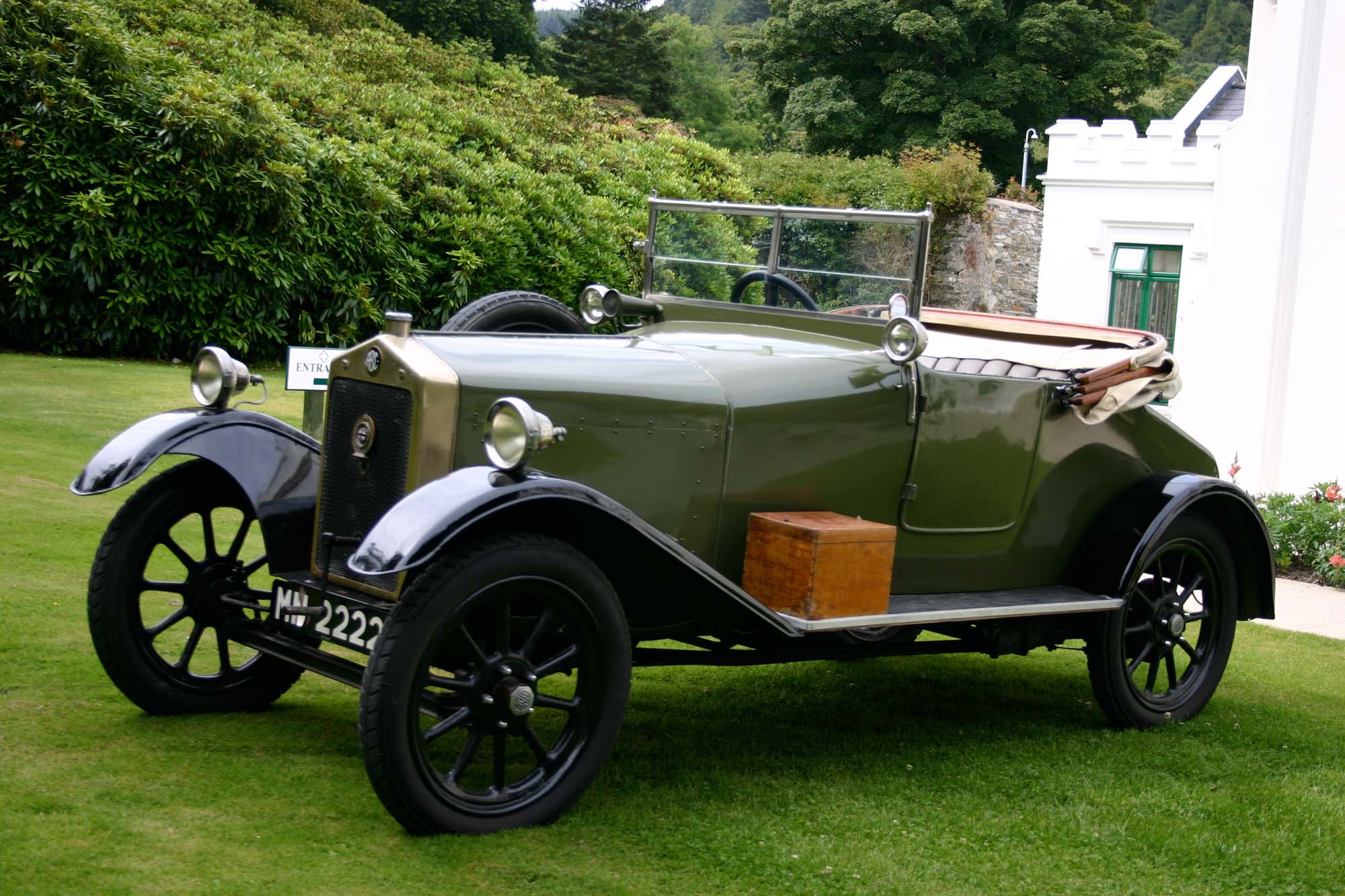
In most respects this is identical to the 1921 car, but as it is the sports version it has a very light two-seater body, with no doors and a fold flat windscreen. Engine wise it differs only in having cast iron cylinders and enclosed valve gear, mainly in an attempt to reduce the noise level, it is certainly better in that respect. It also has two rows of rollers as against one row at the big ends.
Nothing is known of its past history, but it has done very little mileage. A total of eleven ABC cars are known to exist, other than these only two or three are believed to be running. One reason for their low survival rate is that they caught fire easily. The carburetter is situated very close to the unprotected wooden floor boards, these became saturated with oil, and a certain amount of petrol, a good spark or a blow back would soon catch on fire and the petrol tank is above the lot! These floorboards have now been covered with aluminium for a bit of safety. The car being so light the brakes are lethal in the wet.


This car was bought in 1971, after lying some thirty years in a damp shed in Plymouth. Its previous history is unknown except that it seems to have been first registered in Northumberland. It must have covered a very large mileage as much of it was completely worn out. With the body rusted halfway up it was in a dreadful state the wings too were rusted through in many places, there was no hood to speak of, just rags, and no glass in the windscreen. It was in this state that it was bought by lorry to friends in Macclesfield. On a very wet day we managed to get it started, the tyres were blown up, and I was towed in it to Liverpool and dumped on the quayside, there the dock police suggested it would be best to just push it straight in the Mersey! However, I managed to drive it on and off the boat under its own steam, and was then towed to Milntown. It took a full year to restore after stripping it down to the last nut and bolt. The broken chassis was repaired, the wings and panels renewed; luckily many spares were found and in 1972 it went back on the road.
The ABC firm (All British [engine] Company) was originally based at Brooklands Race Track, at the time it was building stationary and aircraft engines, it was eventually, to move to a larger factory at nearby Hersham, in Surrey. Their designer was Mr Granville Bradshaw, a remarkable man, a brilliant engineer and designer, but one who rarely developed anything to the finished article like so many others talented inventors. At that time he especially liked horizontally opposed cylinder engines, both twins and fours, hence the engine in the 1921 ABC an air cooled flat twin of 1200cc. It was originally intended for light aircraft of the 1914/18 war, consequently it is very light with steel cylinders only some 1 1/16 inch thick with thin finning turned from a solid billet of steel. In 1919 there being a surplus of engines it was decided to build a car to use them.
The car, in true Bradshaw fashion, has many unusual features for its time. It is very light, has a four speed and reverse gearbox – with an unusual change, the “gate” being in the vertical plane, so that the lever moves up and down instead of sideways to select the ratios. The engine and the separate gearbox are all mounted on a flat platform sub-frame on the chassis, and can be removed as one unit. It drives through a single plate clutch, and the propellor shaft is enclosed in a torque tube, which includes tubular struts to locate the very light axle. The axle is constructed of two thin sheet steel cones bolted to an aluminium centre containing the differentia; the outer ends being riveted and soft soldered into the wheel bearing housing/cum spring mounting forging. The springs are quarter elliptic and bear on rollers which run on an early form of self lubricating bush made of a woven asbestosan cotton material, this is impregnated with graphite. None of these have had to be renewed – despite the large mileage.
The brakes, on the rear wheels only, have internal expanding shoes for the hand brake, and external contracting for the foot brake, both lined with Ferodo. The footbrake operates through a toggle mechanism which increases the power. It also allows them to operate going backwards, this is often the problem with such band brakes. They work very well, but the car being so light they stop the wheels causing them to skid along the road, particularly if it is wet!
To return to the engine, which as mentioned is very light, of 1200cc it has overhead valves, all bearings are either of ball or roller type and it has aluminium pistons. Nowadays the engine would be described as “over-square” having a bore of 96mm and a stroke of 91mm, said to develop 40 hp. The steel cylinders make it a very noisy engine as they expand rapidly with the heat, the tappet being nil cold, but going up to some 40 thou hot! The crankshaft is a one piece forging, the connecting rods being threaded over before inserting the rollers, these are retained by means of a split spacer. Normally very long lasting, as the oil is pumped in small quantities to replace that “lost” in operation, so that only clean oils is in use. A big advantage in the days when roads threw up a lot of dust. The valve rockers and other parts are lubricated by means of screw down grease caps.
The steering is unusual, a form of worm and nut, and runs in ball bearings. The front axle swivel pins have a ball race to take the thrust pressure, making for light and positive action – in fact it was advertised as “The car you can steer with one finger” and you can! This car has electric starting which cost five pounds extra when new.
It has two seats plus a “Dicky” for children. Civilised, with two doors and an opening windscreen – no wipers then, but a reasonable hood. It had quite a sporting performance for its time, being capable of some 50 mph. Something that causes alarm when filling up at garages is that as the petrol and oil tank is above the engine, the petrol goes in via that radiator cap! The recommended tyre pressure is 75lbs! It is now run at 50!
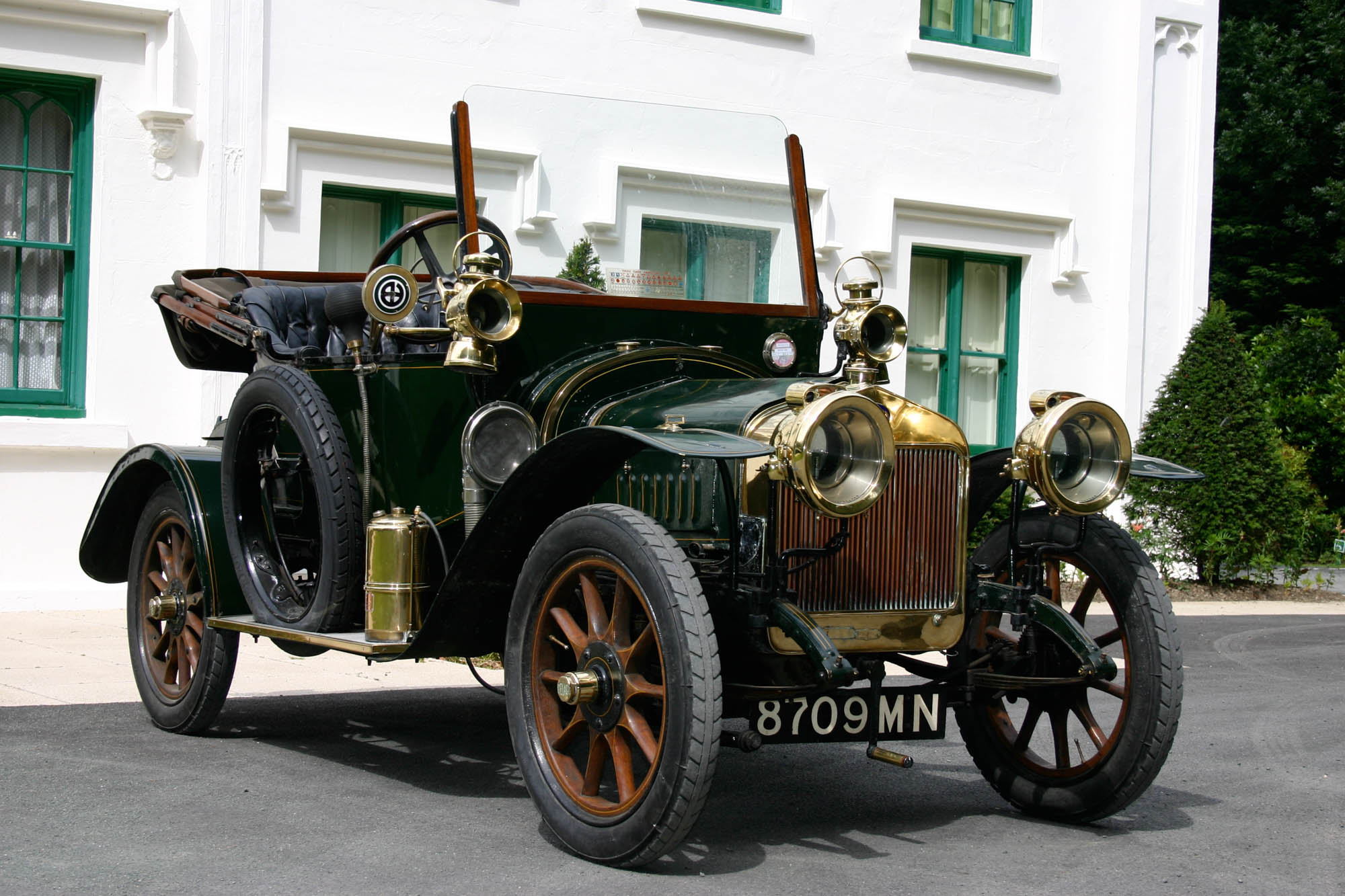
This car was given to Sir Clive in 1945 by Mr Andrews, a solicitor in Swansea, he had bought it second hand in 1911. It was very shabby, having been laid up in 1921. Some of the parts were missing, but he said, “You can have it if I can have a ride in it when you have done it up”. Sadly he died before he could have his ride, but he did see photographs of the completed restoration. In fact, as he got news of the progress being made he kept finding missing parts, these included the lamps – still with their 1914 black-out on, the speedometer, windscreen frame and the hood frames. It is now almost back to the original condition in almost every way, although when made it would not have had the windscreen frame, the hood frames and the door. These, it is thought, were added by the original owner, we have a copy of the “Motor” magazine of 1910 of what appears to be this car (looking just as it does now) in the Manchester Motor Show. It stood on the “Timberlakes” stand, at this time they were the Manchester agents.
It is of course a French made car, very well made with a neat four cylinder engine, believed to have been made by the firm of Ballot, but with Delage cast in badge engineering even then! It has a side valve engine with non detachable head, the valves being inserted through screwed-in caps above them. It has a three speed and reverse gearbox, separate from the engine, and a leather faced cone clutch – this is an aluminium cone shaped wheel which fits into a matching recess in the flywheel. When not in use for a long period this clutch has to be propped out of engagement to prevent the leather facing getting compressed and hard, had this occurred the result would have been a very fierce engagement.
It has a normal back axle, with the propellor shaft enclosed in what is known as a torque tube, this helps to locate the axle. The foot brake operated a normal internal expanding type brake on the back wheels only. The shoes are not lined, being iron castings working directly in the cast iron drums. Only one shoe has ever been renewed. The hand brake operates on the output shaft of the gearbox, and is of the external contracting type, again direct iron to iron.
Ignition is by magento, with no provision for advancing or retarding the timing. The oil and petrol are contained in tanks attached to the dashboard, both feed by gravity to the engine, the oil being returned to the tank by an engine driven pump. There is a combined ignition and oil switch on the dashboard, which also has an oil level gauge showing the amount in the tank. With this system, if the switch is left on with the engine not running, then all the oil drains into the engine, but it soon returns once the engine is started.
The car is extremely comfortable with snug seats, however, there is no provision for adjustment. There are no less than seven springs at the back, three leaf springs and four coil springs, these contain a primitive form of snubber or damper.
There is a folding seat at the back of the body, this is called a “Dicky Seat” it is suitable for two small children or one uncomfortable adult! The view through the window in the hood is not inspiring, in fact the hood itself is not all that effective, though normal for its time. It keeps the rain out when the car is stationary, but when it is moving it funnels the rain round into the back of your neck – on occasion it is drier with the hood down!
The Delage steering is unusual and takes some getting used to as it has no self-centering action, it has to be steered back to the straight ahead line. Delage used this system for many years. The clutch is very heavy and need a strong left leg, more so as gear changing requires double declutching. The gear change is slow but good once the knack is acquired, it requires a degree of “feel” as there is no gate. The positions are located by a spring loaded detent for each gear, reverse being right forward, then neutral and then back one notch for each forward gear. The throttle pedal is central between the clutch and brake, whilst the handbrake moves forward for on. There is an idling speed control on the steering wheel, and an extra air control on the column, this is to admit air to the petrol mixture if the mix is too rich, though it is rarely used.
The two headlamps use acetylene gas, for which there is a generator on the running board forward of the spare wheel. The system needs calcium carbide in the bottom, and water in the top. It has an adjustable feed control to regulate the amount of water dripped onto the carbide, which then produces acetylene gas. The side and rear lamps are fueled by paraffin.
The spare wheel is what is known as the “Stepney Wheel” this is a device which can be clamped to the wheel rim after pushing the faulty tyre to one side. Provision is made for a strap to anchor the Stepney to a spoke, this is to prevent rotation relative to the wheel proper.
The car is slow but reliable, about 25/30mph. It toured Scotland in 1911 and Holland in 1962. It has covered many miles in numerous Vintage Rallies and events.